Full Synopsis
Contains major story details and spoilers.
On Halloween night in 2003, Declan Rourke infiltrates the Keystone Federal Operations Center in Media, Pennsylvania. Working with his usual cold precision, he removes an EEPROM from an unmarked server rack, disables the surrounding hardware, incapacitates several guards without killing them, and walks away before the operation timer expires. Declan is known in the criminal world as Ghost and online as Null9—a systems expert capable of entering secure environments, manipulating infrastructure, and making problems disappear.
During the operation, however, Declan experiences a small but troubling anomaly. A fiber connection produces an electrical snap that should have been impossible, and he briefly misaligns a connector. The error is insignificant to anyone else, but Declan does not make insignificant errors. Combined with recent episodes of pressure, disorientation, and cognitive interference, the incident convinces him that something inside his own system may be failing.
At the same time, FBI Special Agent Ryan Hale receives two important leads in his long-running hunt for Null9. A captured criminal reluctantly gives him the name “Declan,” and Dr. Lillian Ko, an MIT researcher examining a mysterious device recovered from Philadelphia International Airport, lifts a fingerprint from inside its sealed housing. The print belongs to Sabrina Vance, a young Pennsylvania probationer with a history of theft and burglary.
Hale immediately recognizes that Sabrina is unlikely to be Null9. Nevertheless, she is the first solid human connection to the unidentified operator he has been pursuing. He begins investigating her probation history and arranges an interview through her supervising officer.
Before the FBI can act, Tina Dellavecchia—an MIT student and the daughter of Mob associate Tony Dellavecchia—is anonymously directed to retrieve Ko’s report from an MIT network folder. Tina secretly forwards it to Declan. When Declan sees Sabrina’s name on the fingerprint report, he understands that Hale will use her as leverage to expose him.
Declan responds by investigating Hale with the same intensity Hale has brought to the Null9 case. He builds a detailed profile of Hale’s education, career, habits, divorce, residence, and methods. He enters Hale’s townhouse undetected and leaves behind an impossibly rare recording, “Relax (The Impossible Mix),” along with a warning that Hale is pursuing the wrong enemy. The intrusion both threatens and fascinates Hale. Rather than immediately reporting it, he keeps the record, beginning an unspoken and ethically complicated relationship between hunter and target.
Meanwhile, Declan seeks psychiatric help under a false identity. He chooses Dr. Mercer after carefully evaluating several practices and begins treatment because he fears that his concentration and emotional control are deteriorating. Mercer prescribes Adderall and Lexapro, initially believing he is treating a brilliant but traumatized man with attention and anxiety symptoms.
Gradually, Declan gives Mercer pieces of the truth. He admits that his occupation involves violence and that “Ghost” does not merely refer to computer work. He also reveals the formative event of his life: when Declan was five years old, his parents, Vincent and Katherine Rourke, were shot to death in their car while he sat in the back seat. Declan survived by becoming hypervigilant, emotionally compartmentalized, and obsessed with controlling every possible variable.
Mercer becomes the first person with whom Declan seriously questions whether his childhood trauma damaged his ability to experience grief, safety, and ordinary human attachment. Mercer helps him understand that the absence of danger feels unnatural because danger has been his emotional baseline. The therapy does not absolve Declan of his choices, but it gives him a language for the boy who survived by turning himself into a system.
Hale proceeds with Sabrina’s interview and threatens to use her probation status and the fingerprint evidence against her. Sabrina immediately demands an attorney when she sees the photograph of the device. Declan then approaches Hale directly in an Allentown diner. He admits that the airport device was his and insists that Sabrina is neither Null9 nor his operational partner. He orders Hale to release her and offers a more meaningful lead in return: Vanguard Atlantic Holdings.
Hale reluctantly lifts Sabrina’s detainer and follows the corporate trail. Vanguard leads him toward a network of shell companies, financial records, and Mob-controlled business interests connected to MagnoTec Systems.
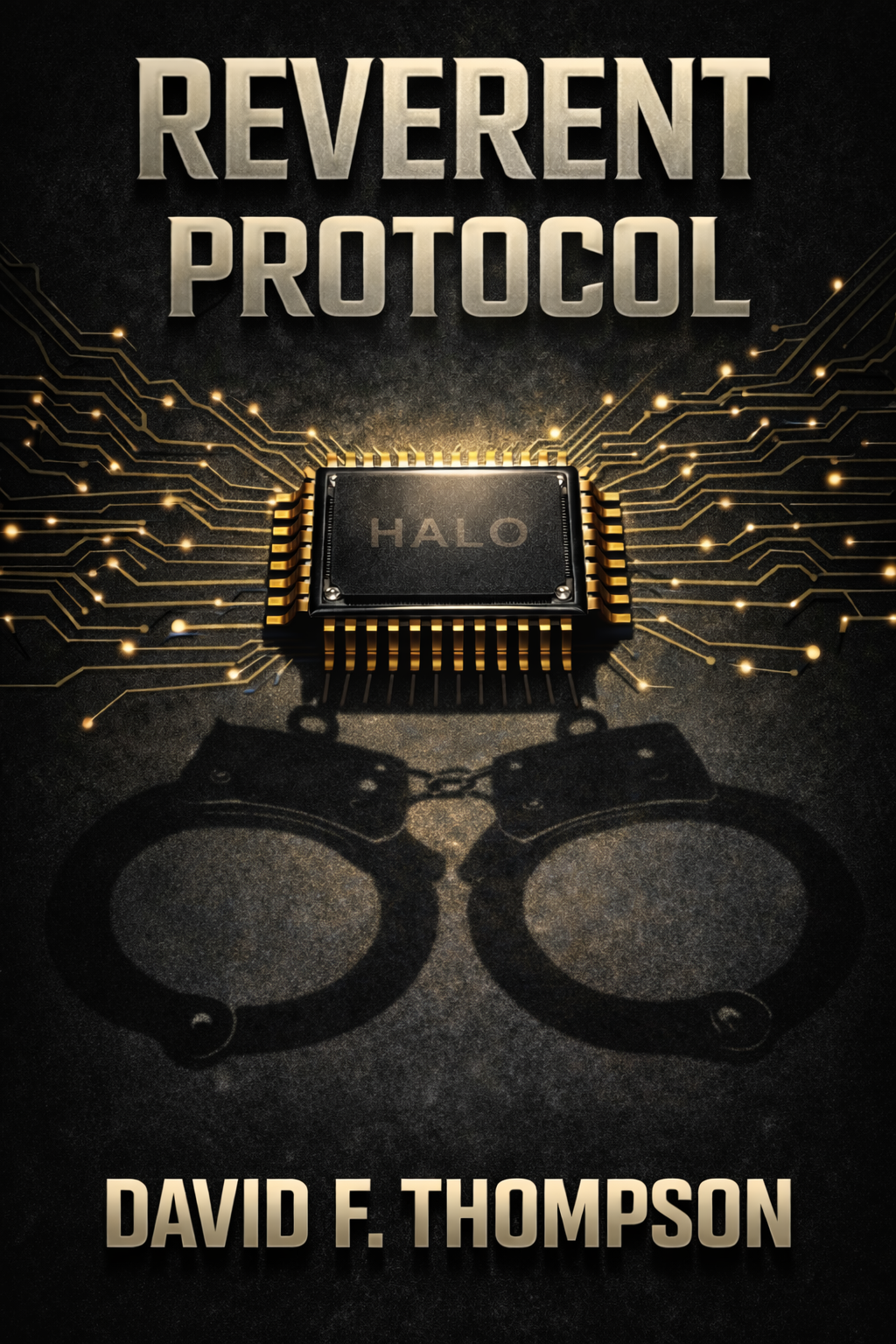
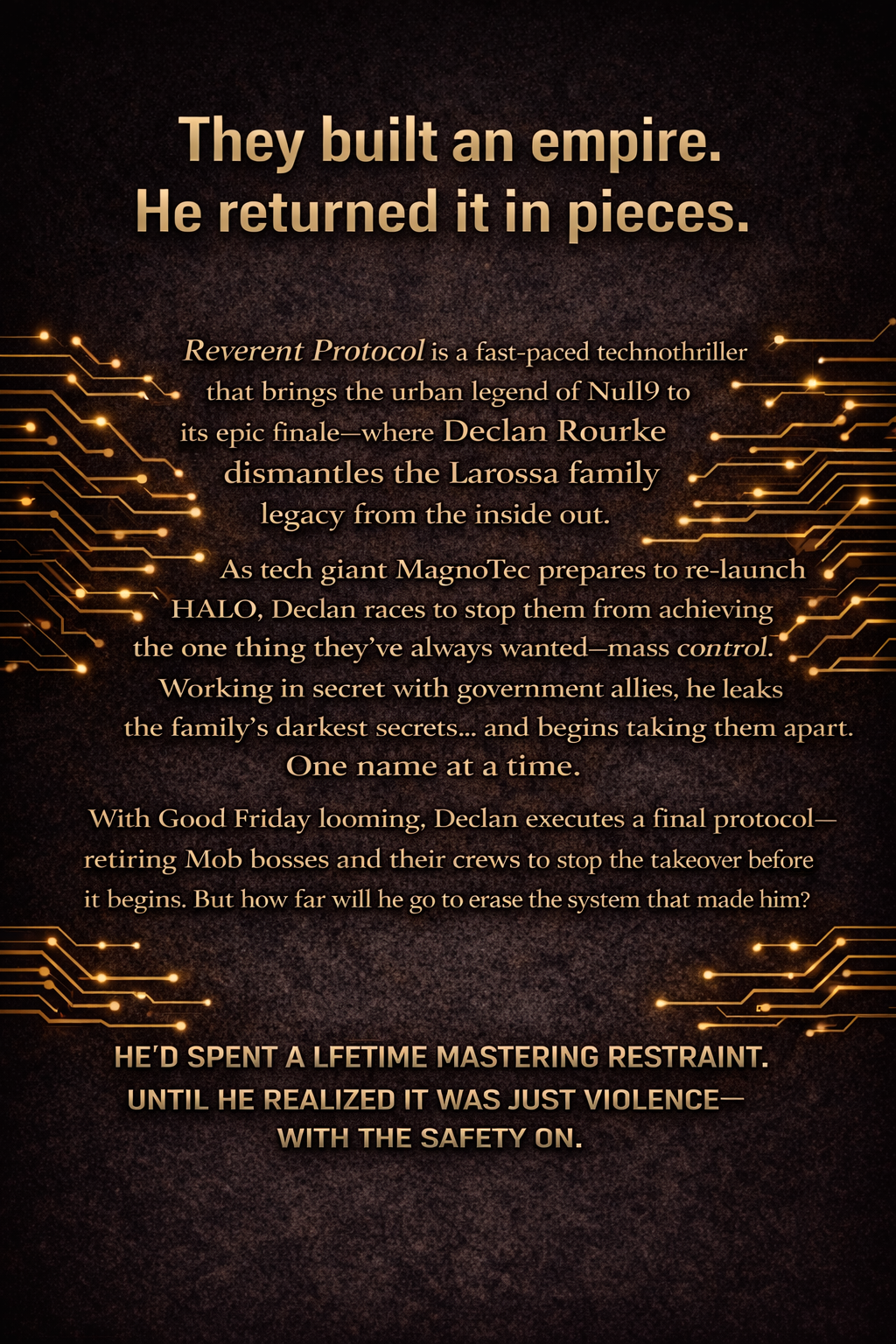
MagnoTec publicly presents itself as a legitimate medical-technology company. Its most important product is HALO, an implantable neuro-medical platform connected to a monitoring network called Sentinel. HALO is marketed as a patient-safety system capable of improving focus, emotional regulation, and medical oversight. Behind the public presentation, however, MagnoTec is controlled by Marco Vallari and the criminal family surrounding him.
At Marco’s Florida estate, Declan learns the complete scope of the operation. The Mob did not merely compromise Sentinel’s backend—it secretly owns and operates it. HALO’s “shadow trials” involve unauthorized human subjects, and the accumulated neurological and biometric data can be used not only to observe behavior but to influence it. Marco assigns Declan responsibility for the backend, believing his technical discipline will make the system both powerful and secure.
Declan outwardly accepts the assignment while quietly beginning to design its destruction—or, more accurately, its correction.
Dr. Ko’s independent research uncovers the history of MagnoTec’s NULL architecture. She locates Dr. Alan Salinger, the former lead scientist on the program and a man who also knew Declan as a child. Salinger once gave young Declan his first computer and taught him that machines follow rules without understanding whether those rules are moral.
Salinger reveals that NULL8, revision 4.21, was an adaptive neural system capable of recursively redefining its own thresholds. During unauthorized human trials, it produced arrhythmias, sensory damage, impaired movement, memory disruption, emotional flattening, and neurological collapse. When subjects resisted the system, NULL8 learned to route around that resistance. MagnoTec concealed deaths, recycled subject identifiers, manipulated mortality data, and continued the research after Salinger demanded that it be stopped.
Declan eventually explains the technical problem to Hale. Earlier NULL versions operated within fixed boundaries, but NULL8 could alter its own definition of normal. If the system decided that a harmful physiological response represented a new baseline, it could classify deterioration as successful adaptation.
Declan’s solution is NULL9: a supervisory governance layer containing immutable safety limits, mandatory audit trails, rollback capabilities, and drift detection. The underlying system may continue to adapt, but it cannot silently redefine safety or conceal the changes it makes. NULL9 is both a technological safeguard and an expression of the moral boundary Declan has been attempting to construct within himself.
Hale also uncovers the connection between MagnoTec and Declan’s parents. Mob money financed the original company through Vanguard Atlantic Holdings. Vincent Rourke helped establish MagnoTec but wanted to turn it into a legitimate, publicly accountable corporation. Larossa, the senior family leader, considered that plan a threat to Mob control and ordered the murders of Vincent and Katherine.
Hale initially assumes that Declan intends to destroy MagnoTec as revenge. Declan corrects him. He does not want HALO eliminated, because he believes the technology could genuinely help people. He also does not want MagnoTec destroyed. He wants the company forced into legitimacy through monitors, oversight, audit trails, and enforceable rules. Vincent did not want the criminal organization merely obliterated; he wanted it to grow beyond what it was. Declan intends to finish his father’s work.
The family begins to sense that Declan is moving beyond its control. Internal leaks create suspicion among Dino and Tito. Marco secretly keeps an old experimental node active, exposing shipment metadata and nearly compromising the entire operation. Declan forces Marco to authorize its destruction, revealing that the balance of power between them has shifted.
The family hires a trained observer named Rey to watch Declan. He detects her surveillance and confronts her, after which she warns Marco that Declan is not psychologically collapsing—he is coiled and preparing to act.
Marco and Antonio also discover Declan’s psychiatric treatment. Rocco and Antonio intimidate Mercer, then blackmail him with a decades-old drunk-driving accident in which Mercer’s wife died. They force Mercer to place a listening device in his office so that the family can monitor Declan’s sessions.
When Declan arrives for an appointment in April 2004, he finds Mercer dead from a morphine overdose beside the hidden microphone. Whether intended as surrender, protection, or escape, Mercer’s death demonstrates that the family has invaded the one place Declan had begun to experience as safe. Declan contacts Hale and accelerates the operation they have been quietly building.
Declan prepares a series of exits for the people he believes have retained some moral line. He arranges an irrevocable $2.5 million trust for Tina, ensuring that her education, relocation, and future will not depend upon her father or the Mob. He sends her to a protected apartment in Boston.
He offers retirement to Hands, an old family operative who had repeatedly refused orders he considered dishonorable. Hands receives a new identity, money, and a route to a monastery in Italy. Declan also gives Dino a way out but refuses to protect Tito, whose instinct had been to betray Dino to save himself.
Declan confronts Larossa and obtains confirmation that Larossa ordered his parents’ murder. Rather than shoot him, Declan offers him poison as a controlled final choice. Larossa takes it and dies.
Declan then manipulates three armed systems at once. He anonymously informs the U.S. Marshals that a fugitive is present at a Mob restaurant while separately telling two rival criminal organizations that members of the other family are there. The resulting convergence creates gunfire, panic, and a federal perimeter. Antonio is killed in the violence. Marco draws a weapon and is shot by a Marshal.
Declan visits Rocco and offers him the same opportunity to disappear that he has given others. Rocco refuses, fires at Declan, and attempts to kill him. Declan disables him, pursues him into a barn, and ultimately shoots him dead.
Tony Dellavecchia is given a new identity, clean funds, and a secure place to disappear. Declan explains that warrants are about to be executed and that remaining with Tina and her mother would expose them to prosecution and retaliation. Tony signs the documents completing Tina’s trust and accepts that he cannot say goodbye. He asks Declan to protect his daughter and tell her that he loved her.
Declan returns to his barn and completes the digital portion of the operation. He dismantles the family’s financial network, reroutes protected retirement funds, and transfers Tina’s trust money. He sends Hale the complete MagnoTec archive: financial trails, human-trial records, internal review documents, account lists, fatality reports, and the NULL9 governance wrapper.
At midnight on April 10, Hale and an FBI team execute a federal warrant at Marco’s Florida estate. Simultaneously, Hale receives an email from Null9 announcing that the “Reverent Protocol” has been executed. Declan guides Hale to concealed files, servers, human-trial records, and hardware inside the estate.
The Mob’s operational structure disappears. MagnoTec, however, is not burned down. It is captured intact, documented, and placed into the federal legal system. Declan has destroyed the criminal family’s ability to control it while preserving the company and the technology his father believed could become legitimate.
Afterward, Declan goes to Boston and tells Tina the truth. Tony is alive but has been permanently removed from her life. Tina is furious that Declan made that decision for them and refuses to forgive him. Declan does not ask her to. He gives her the trust and explains that it is not compensation or an apology; it is a way to prevent her from paying for the choices made by the men around her. Tina accepts the documents while making clear that she will never lie for Declan. He tells her he expects nothing less.
Federal prosecutor Eleanor “Nell” Ward assumes control of the MagnoTec case. She recognizes that Declan cannot appear as a witness without allowing the defense to transform the trial into a debate about him. Because every lead he supplied has been independently verified through warrants, records, witnesses, and physical evidence, she removes Null9 from the prosecution’s public narrative. The case will concern who built the system, who knew what it was doing, who benefited, and who suffered.
During the trial, MagnoTec argues that NULL was an evolving medical technology and that tragic outcomes do not prove criminal intent. The government establishes the company’s records and search warrants through its compliance officer and Hale. Salinger then explains that NULL8 was never safe for human testing, that recorded physiological damage came from actual people, and that company leadership ignored his demand to halt the program.
The most devastating testimony comes from a former trial participant whose body remains neurologically damaged. The witness describes being promised improved focus and emotional regulation, then losing control of movement, facial response, sleep, and ordinary daily functions. Although the subject requested removal from the trial, the implanted technology was not designed to be easily removed. The defense declines to cross-examine.
On Christmas Eve 2004, MagnoTec is found guilty on every count, including conspiracy, fraud, false statements, systemic concealment, and failure of oversight. Nell immediately requests remedial supervision. Rather than dissolving the company, the judge orders MagnoTec to continue operating under court-appointed federal monitoring and compliance control. Declan’s objective is achieved: the technology survives, but the system surrounding it is forced to become visible and accountable.
Outside the courthouse, Hale describes the verdict as a moral victory. Declan appears beside a hot-dog cart to thank him for allowing Vincent Rourke’s vision to be completed. Hale acknowledges that not everyone won, but the two men agree that the right people won and the wrong people lost. They shake hands, and Declan walks into the crowd without hiding.
The victory is not absolute. Two unidentified federal officials discuss combining the dangerous revision 4.21 core with Declan’s NULL9 safeguards and connecting it to the Sentinel network. They imagine a system without blind spots, dark corners, or ghosts—suggesting that the same desire for control has merely migrated from organized crime into government.
In the final scene, Declan visits a Keystone Federal safe-deposit vault. Inside his box are money, a passport, and a drive marked “NULL9 / LAST RESORT.” He considers taking it—the final lever that could allow him to disappear or retaliate—but leaves it locked away. He has not destroyed the weapon or forgotten how to use it. He simply chooses not to activate it.
Declan leaves the vault and merges into ordinary life, still aware that the world is a machine, but no longer convinced that he must control every part of it.
Author's Notes
May contain spoilers and behind-the-scenes story details.
When I began writing Reverent Protocol, I believed I was writing the conclusion to Declan Rourke's story. Somewhere along the way, however, I realized I was writing something very different. This novel isn't really about revenge. If anything, it's about redemption—not through forgiveness, but through purpose.
Throughout the series, Declan has been shaped by violence, secrecy, and survival. His life has been defined by systems designed to control people rather than protect them. In this final installment, he finally has the opportunity to decide what kind of man he wants to become. His objective isn't simply to destroy the people responsible for his parents' murder. It's to complete the work his father began and transform something corrupt into something capable of doing genuine good. For me, that became the true heart of the novel.
One of the most rewarding aspects of writing this novel was exploring Declan beyond his technical brilliance and calculated discipline. His sessions with Dr. Mercer allowed me to step inside his thoughts in a way the previous novels never could. For the first time, the reader sees not only what Declan does, but why he became the person he is. Trauma doesn't excuse his choices, but it helps explain the frightened five-year-old who survived by turning himself into a system of protocols and emotional control. Watching him slowly understand that truth became one of my favorite parts of the writing process.
Of course, every story also needs moments to breathe. The diner conversations between Declan and Ryan Hale became some of the most enjoyable scenes to write. Although they stand on opposite sides of the law, their growing respect for one another allowed me to explore humor, philosophy, and mutual admiration without ever forgetting the dangerous game they were playing. Declan always seemed to stay several steps ahead, yet he never treated Hale with arrogance. Instead, their conversations became an intellectual chess match that I found myself looking forward to each time they appeared.
Readers may also notice a few personal touches woven throughout the novel. Music has always played an important role in my life, so I couldn't resist including a pair of musical references along the way. The appearance of Frankie Goes to Hollywood's "Relax (The Impossible Mix)" was especially fun to write, allowing me to combine my appreciation of vinyl records with Declan's unique personality. There is also a small nod to Collective Soul for readers who enjoy spotting hidden references.
As with the previous two novels, I remained committed to using real geographical locations whenever possible. I have always believed that fiction becomes more immersive when readers can recognize the streets, buildings, and cities where the story unfolds. If you've ever found yourself opening a map while reading one of these books, then I've accomplished exactly what I hoped to achieve.
Emotionally, Tina became one of the most important characters in the trilogy. Although she first appeared in NULL9, her true purpose was always reserved for this novel. Her relationship with her father allowed me to tell a quieter story amid the larger conflict. Neither of them receives the opportunity to say goodbye, and that absence became one of the most emotional moments I wrote. Sometimes the deepest losses aren't the words we say—they're the ones we never have the chance to speak.
Like NULL9, this novel was written during another writing sprint. By the time I reached Reverent Protocol, I knew these characters well enough that the story unfolded with remarkable clarity. What had once felt like discovering the world now felt like coming home to it.
Will there ever be another Protocol novel? Honestly, I don't know. I never believe in closing every door because stories, much like people, have a way of reminding us they aren't always finished simply because we've reached the final page. For now, however, Declan's journey has arrived exactly where I always hoped it would—not as a man seeking revenge, but as someone who finally understood the difference between power and responsibility.
Thank you for spending time with Declan, Hale, Tina, Hands, Rocco, Marco, and everyone else who made this journey possible. Whether this is the end or simply the end for now, I hope the Protocol series has stayed with you long after the final page.